
This guide starts where our repair or replace guide ends: you have decided to replace. Most homeowners go through this once every decade or two, so the sequence of visits, paperwork and decisions is unfamiliar. Below is the order things typically happen in and what to ask at each step.
San Antonio Residential HVAC is a free quote service: we connect San Antonio-area homeowners with independent, TDLR-licensed local HVAC contractors for free, no-obligation quotes. The contractor you choose diagnoses, quotes, pulls the permit and does the work directly with you.
Step 1: the sizing visit and the Manual J
A good contractor measures before quoting. A Manual J load calculation estimates how much cooling and heating your house needs from square footage, insulation, window area and orientation, air leakage, ductwork and where the equipment sits. Ask for it before you accept any tonnage; one published cost guide notes some contractors charge for it but waive the fee if hired.
Copying the old nameplate inherits whatever mistake was made last time. A DOE Building America case study of a San Antonio builder found that sealing the attic, turning a roughly 130 °F vented attic into an 80 °F space, let the builder downsize the air conditioner by half a ton. The right size depends on the house as it is today.
The visit should also include the ducts. Attic ducts are common here, and ENERGY STAR says 20 to 30 percent of the air moving through a duct system can be lost to leaks; a new system will not fix that. Our attic ducts guide covers what to look for.
Step 2: choosing the equipment
Three rules shape what can be installed in Texas, and the quote should reflect all of them. This is general information, not legal advice.
- Efficiency minimums. Texas is in the DOE's Southeast region: a new split central AC under 45,000 Btu/h (under roughly 4 tons) must be at least 14.3 SEER2, 13.8 for larger units, and a split heat pump at least 14.3 SEER2 and 7.5 HSPF2. Lower-rated equipment cannot be installed here.
- Refrigerant. Since January 1, 2025, new residential split systems must use a refrigerant with a global warming potential under 700, in practice R-454B or R-32. EPA's May 21, 2026 rule lets systems whose components were all made or imported before 2025 be installed until that stock runs out, so an R-410A quote is legal if it is pre-2025 inventory. Ask which you are getting; our refrigerant change guide explains the trade-offs.
- Matched components. The condenser, coil and furnace or air handler are rated together; CPS Energy verifies efficiency with an AHRI certificate matching those model numbers.
Step 3: the written quote
Get two or three itemized written quotes listing every component's model number, the SEER2 and HSPF2 ratings, the refrigerant, the AHRI certificate, whether the line set, pad, thermostat and drain are new or reused, any duct work, the permit, the schedule and payment terms. Texas rules require the company's TDLR license number (TACLA or TACLB followed by digits) on proposals and invoices; look it up at TDLR's license search.
| Item | Typical range |
|---|---|
| New central AC, installed (3 tons) | $5,000–$12,000 |
| AC + furnace replacement, San Antonio (3 tons, minimum efficiency) | $9,000–$12,000 |
| Heat pump, installed | $5,000–$15,000 (San Antonio 3-ton with air handler: $9,000–$12,000) |
| Furnace replacement | $2,800–$7,500 |
| Ductwork replacement | about $2,000–$3,000 per ton in San Antonio (3 tons: $6,000–$9,000) |
The wide ranges reflect equipment tier and how much of the system is being replaced. The San Antonio HVAC cost guide has a calculator for the combinations.
Step 4: the permit
A replacement needs a city mechanical permit in San Antonio and the suburbs we checked. The City of San Antonio's Development Services Department says trade contractors licensed by the city or state and registered with the city may obtain trade permits; mechanical permits are not on the homeowner list. The contractor pulls it. New Braunfels, Boerne and Universal City require contractor registration with the city, and Live Oak's 2026 FAQ requires a permit, a final inspection and a duct-leakage test if ductwork was replaced. For Schertz, Converse, Helotes and Cibolo, check with the city. Our permits guide has details. This is general information, not legal advice.
A quote that skips the permit is a warning sign, and it also blocks the next step.
Step 5: CPS Energy rebates and paperwork
CPS Energy's residential program for February 1, 2026 through January 31, 2027 lists rebates of $90 to $310 per cooling ton for central AC, heat pumps and mini splits by SEER2 tier: $115 to $310 for early replacement and $90 to $275 for replace-on-burnout. The conditions matter at this stage:
- Inside San Antonio city limits, the permit number must be provided.
- The AHRI certificate must match the new condenser, coil and furnace, and the invoice must list model and serial numbers.
- For the early-replacement rate, the old equipment must still work and be under 25 years old (central) or under 20 (heat pump), with photos and nameplate details taken before removal.
- The application must be received within 30 days of installation.
Check availability before you count on it. CPS Energy rebates are first-come, first-served, and the rebate page showed "Out Of Stock" on October 21, 2026. Decide with the contractor before install day who photographs the old unit and who files, and check CPS Energy for current availability. Our CPS rebate guide walks through the form.
Step 6: install day
In general terms; your contractor's sequence may differ:
- Prep. Power off, work areas covered. Clear a path to the attic hatch or closet and the outdoor unit.
- Refrigerant recovery. The old refrigerant is recovered, not vented. Only an EPA Section 608 certified technician should do this.
- Removal. The old condenser, coil and, if included, furnace or air handler come out, after any rebate photos are taken.
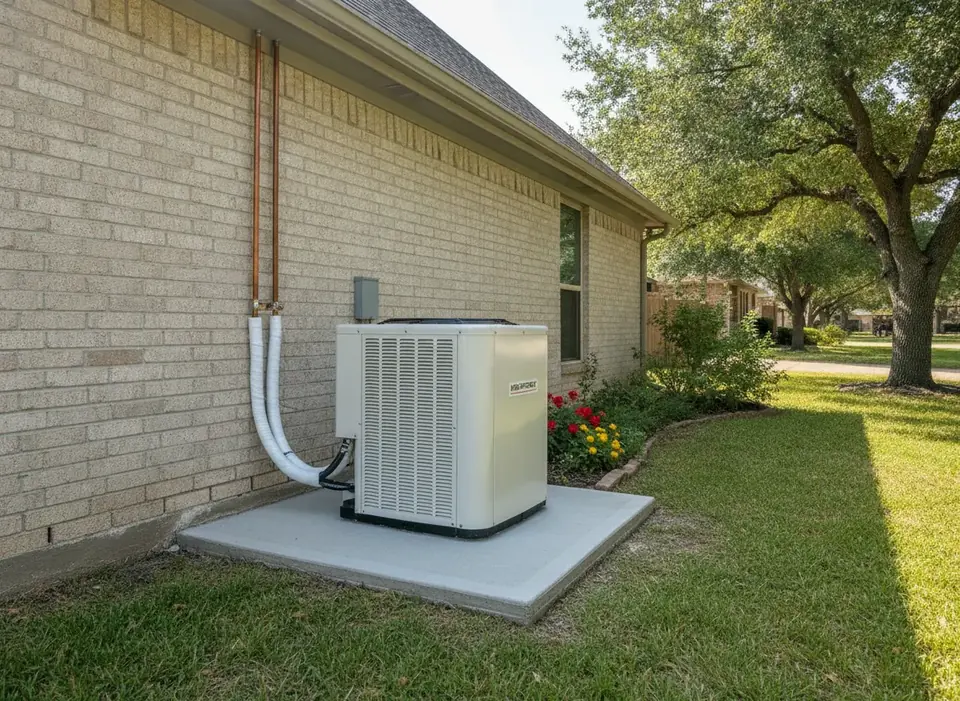
- Setting the new equipment. Condenser on the pad, coil or air handler set, line set flushed or replaced per the quote.
- Connections. Electrical, gas, condensate drain and duct transitions. In an attic, the secondary drain pan and float switch belong here.
- Charging, start-up and walkthrough. The system is evacuated, charged to specification and run; airflow, temperature split and amp draws should be recorded for you, and the crew shows you the filter, drain and shut-offs.
Step 7: after the crew leaves
- Inspection. The city's mechanical final, plus Live Oak's duct test if ducts were replaced.
- Paperwork. Keep the invoice, AHRI certificate, permit number and warranty terms together, and file the CPS application within 30 days.
- Filters and maintenance. ENERGY STAR says to check the filter monthly. Plan a check-up before next summer; our maintenance page and fall checklist cover what it should include.
The AC replacement page explains how quotes work. When you are ready, request free quotes and ask each contractor for the Manual J, the AHRI certificate and the permit in writing.
Frequently asked questions
How long does an HVAC replacement take in San Antonio?
Published guides give no San Antonio-specific figure, and it depends on the job. A like-for-like change-out of the outdoor unit and indoor coil is typically shorter than one that also replaces the furnace or air handler, and replacing attic ductwork adds time. Ask each contractor for an estimated schedule in the written quote, including the permit inspection.
Do I need a permit to replace my AC in San Antonio?
Yes. The City of San Antonio's Development Services Department says trade contractors licensed by the city or state and registered with the city may obtain trade permits; mechanical permits are not on the homeowner list. The contractor pulls it. Inside city limits, CPS Energy also requires the permit number for an HVAC rebate. This is general information, not legal advice.
What size HVAC system do I need?
Nobody knows until a Manual J load calculation is done on your house. It accounts for square footage, insulation, windows, orientation, ductwork and the attic. Replacing a unit with the same tonnage as the old one skips that step. Ask for the calculation; one published cost guide notes some contractors charge for it but waive the fee if hired.
How much does HVAC replacement cost in San Antonio?
Published cost guides (2024 to 2026) put a new 3-ton central AC at about $5,000 to $12,000 installed, a 3-ton AC and furnace replacement in San Antonio at about $9,000 to $12,000 at minimum efficiency, and a 3-ton heat pump with air handler at about $9,000 to $12,000. Ductwork replacement adds about $2,000 to $3,000 per ton locally. Estimates, not quotes.